
The 6 Words That Almost Got an NVIDIA Exec Fired
And a 3-step framework from NVIDIA for breaking the unwritten rules that hold you back.

Hit the ‘❤️ Like’ as a small offering to the algo gods.


The instant messages started flashing in Deb Shoquist’s inbox.
“Stop!”
“Stop, don’t go there.”
“Try to listen to him.”
They were sitting around a conference table at NVIDIA, the air thick with the quiet hum of laptops and corporate tension.
Debora Shoquist, NVIDIA’s Head of Operations, was locked in an argument with her boss, CEO Jensen Huang.
The fight was over time. A key Taiwanese packaging partner had a three-week lead time, the industry “standard”. This supplier packaged TSMC’s hardware, the chips at the heart of NVIDIA's products. Huang wanted it pulled forward to keep an aggressive build on track.
Pushed to her limit, Shoquist finally uttered the six forbidden words to Jensen Huang:
“You don’t understand how this works.”

It was a gutsy, almost career-suicidal move. But she truly believed she was right.
The room went silent. Huang’s face hardened. He erupted not just questioning her conclusion, but her very identity. “I thought you were an ops person,” he shouted. “You’re not an ops person!”
Furious and determined to prove him wrong, Shoquist jumped on a plane to Taiwan. After a week of digging, she uncovered the truth. The official lead time for delivery, which everyone accepted, was three weeks. But the actual cycle time, the pure hands-on work time, was only 36 hours.
In other words, that three-week wall was a mirage. It was tradition, not physics. Expediting the process would be wildly expensive, but it was possible.
Huang had been right.

Shoquist flew back to California and presented her findings, bracing for another tirade of insults. Instead, Huang examined the data and said calmly, “That’s the right answer.”
This clash wasn’t about ego or insubordination; it was the birth of a philosophy Huang called the Speed of Light. But the name is a beautiful deception.
Huang wasn’t demanding people simply work faster. He was laying out a framework for seeing reality more clearly than the competition.

This mindset became NVIDIA’s secret weapon, giving them the foresight to start building the engine for the AI revolution a full decade before it arrived. In fact, Huang started betting on GPU-accelerated AI in the late 2000s… well before others believed in it. Today, that AI bet looks clairvoyant.
🚨 Quick sidebar: If you want to support my work, here are two ways to help:
Children’s book: I recently started adapting these mental models for younger readers, simple stories and big questions for curious minds at home or in a classroom. You can buy the book on Amazon.
Screenwich: This is a small side project with friends: a free tool that makes analysing and valuing stocks a little easier. Sign up now! It’s free.
The Map of "Fast"
Let's be clear: the speed of light framework has almost nothing to do with speed.
As explained in the book, Thinking Machine by Stephen Witt1,
At its core, the Speed of Light framework is a method for separating the laws of physics (what is truly unchangeable) from the corporate rituals (what feels permanent but isn't).
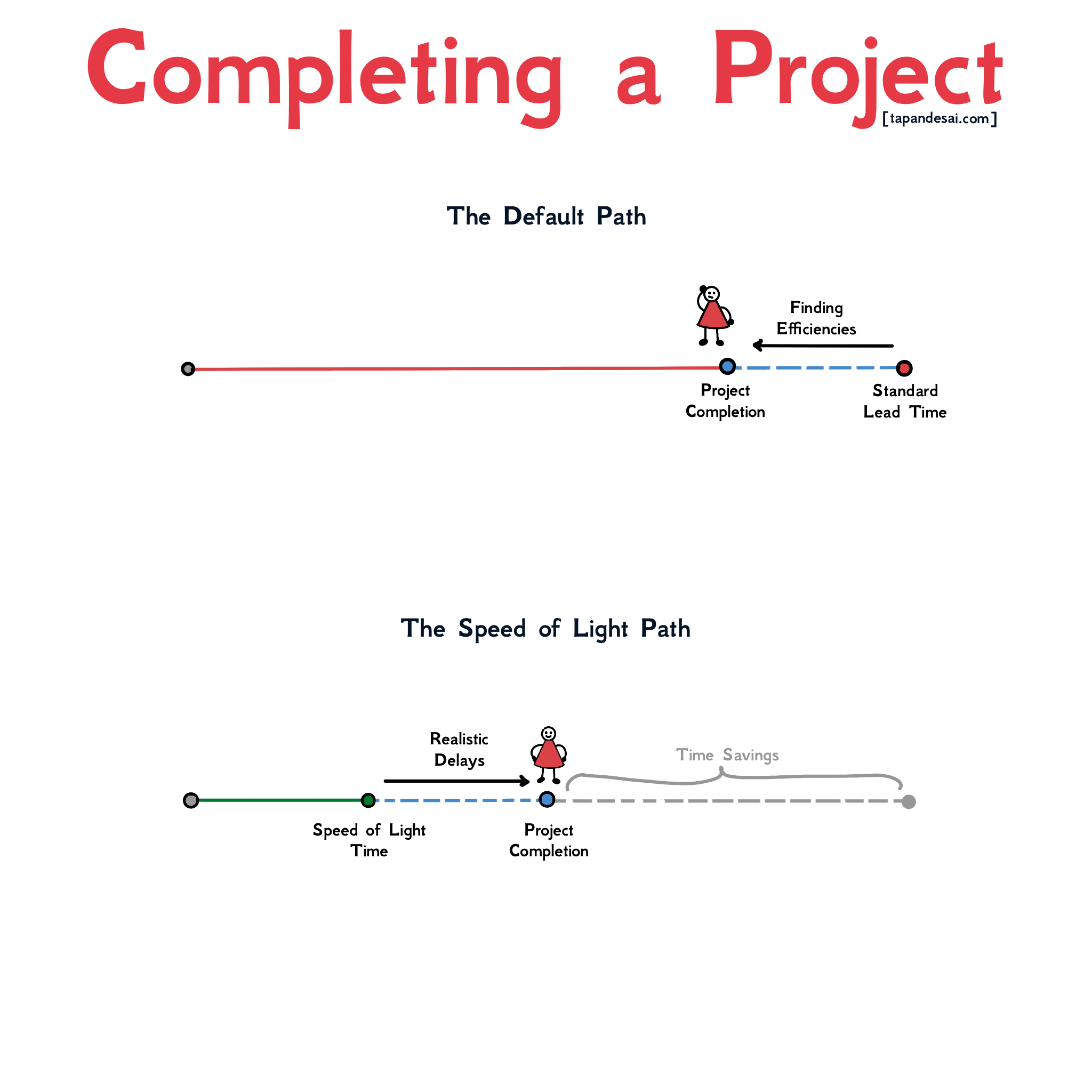
It’s the difference between the 11-hour reality of flying to New York and the theoretical 3.5 hours it would take if your Uber to the airport was a helicopter and your flight was supersonic.
It’s a simple, three-step process for remapping work.
Step 1: Define the "Speed of Light"
Begin with a thought experiment: imagine a world with zero friction - no meetings, instant approvals, and hot coffee magically refilled at your desk.

Ask yourself, “What is the absolute fastest this task could theoretically be accomplished if every single thing went right?”
This isn’t your goal; it’s a benchmark. The North Star of what’s physically possible.
For example, suppose you need to prepare a critical client presentation. In the “speed of light” version of this project, the core idea hits you in a flash, the data you need lives neatly on your drive, and your manager (a beacon of decisiveness) approves your outline instantly.
The result of this fantasy? Maybe two hours of work. That’s your number. It’s not a deadline; it’s an anchor.
Step 2: Acknowledge Reality
Now come back down to Earth and list every force that drags your two-hour ideal out into a five-day slog. These are the real-world frictions, your “lead time”.

For our presentation example, the obstacles might look like this:
📊 The data you need is scattered across three different departments.
⏳ The analytics team has a 48-hour SLA for data requests.
🔁 Your manager’s feedback requires multiple review cycles.
🗓️ Your calendar is a graveyard of unrelated meetings that eat up hours.
This swamp of dependencies, delays, and distractions is the real enemy. These are the bottlenecks turning 36 hours of actual work into three weeks of waiting.
Step 3: Work Backward from Light Speed
Now, flip your perspective. Don’t ask, “How do I make the five-day process 10% faster?” Instead ask: "Which of these constraints are laws of physics (non-negotiables) and which are just corporate habits?"
This is the crux of Huang’s approach.
Some constraints will be immovable (for now) - a hard 48-hour data turnaround might truly be unavoidable given current systems. But many constraints are simply conventions begging to be broken. Is there an unwritten rule that you can’t show a rough draft to your manager? Break it. Send a scrappy one-pager of your idea while you wait for the data. Who says you can’t get early feedback? By doing so, you’re not just saving time; you’re attacking the friction directly.

Starting from the “impossible” ideal forces you out of incremental mode and into redesign mode. Instead of squeezing out a few percent improvement, you rethink the entire workflow. You challenge each delay to justify its existence.
Because most walls at work are made of fog. They look solid until you try to walk through them.
Delete the Default
Why does this feel radical? Because our brains love the default. Status quo bias - It's our natural tendency to stick with what's familiar, which tricks us into thinking the old way is the best way.
Most teams work by analogy: “We do it this way because we did it this way.” That’s cover-band thinking. The Speed of Light framework forces composer thinking, strip the song to its notes and writes a better one.
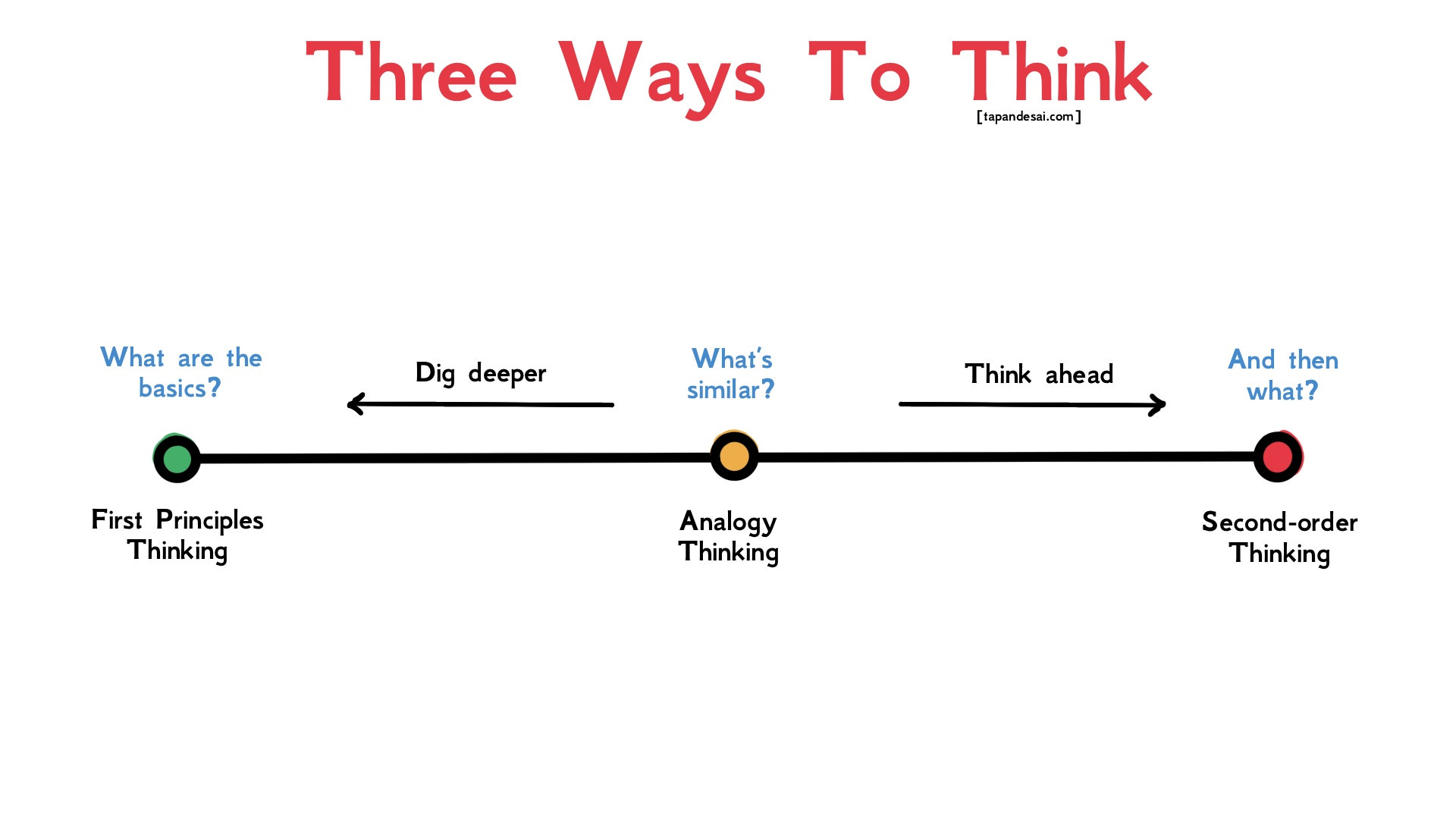
Consider the suitcase. For decades, flying meant carrying a heavy box by a handle. Everyone accepted the “law” of luggage: you lug it. In 19722, Bernard Sadow put wheels on a suitcase and patented rolling luggage. It helped, but it was still a box you dragged flat behind you. In 1987, pilot Robert Plath turned the case upright, added two wheels and a telescoping handle, the Rollaboard, and crews (then passengers) adopted it en masse!
The breakthrough wasn’t “walk faster.” It was: what’s the physics, what’s the friction and which part is just tradition?
In essence, it’s first principles thinking.
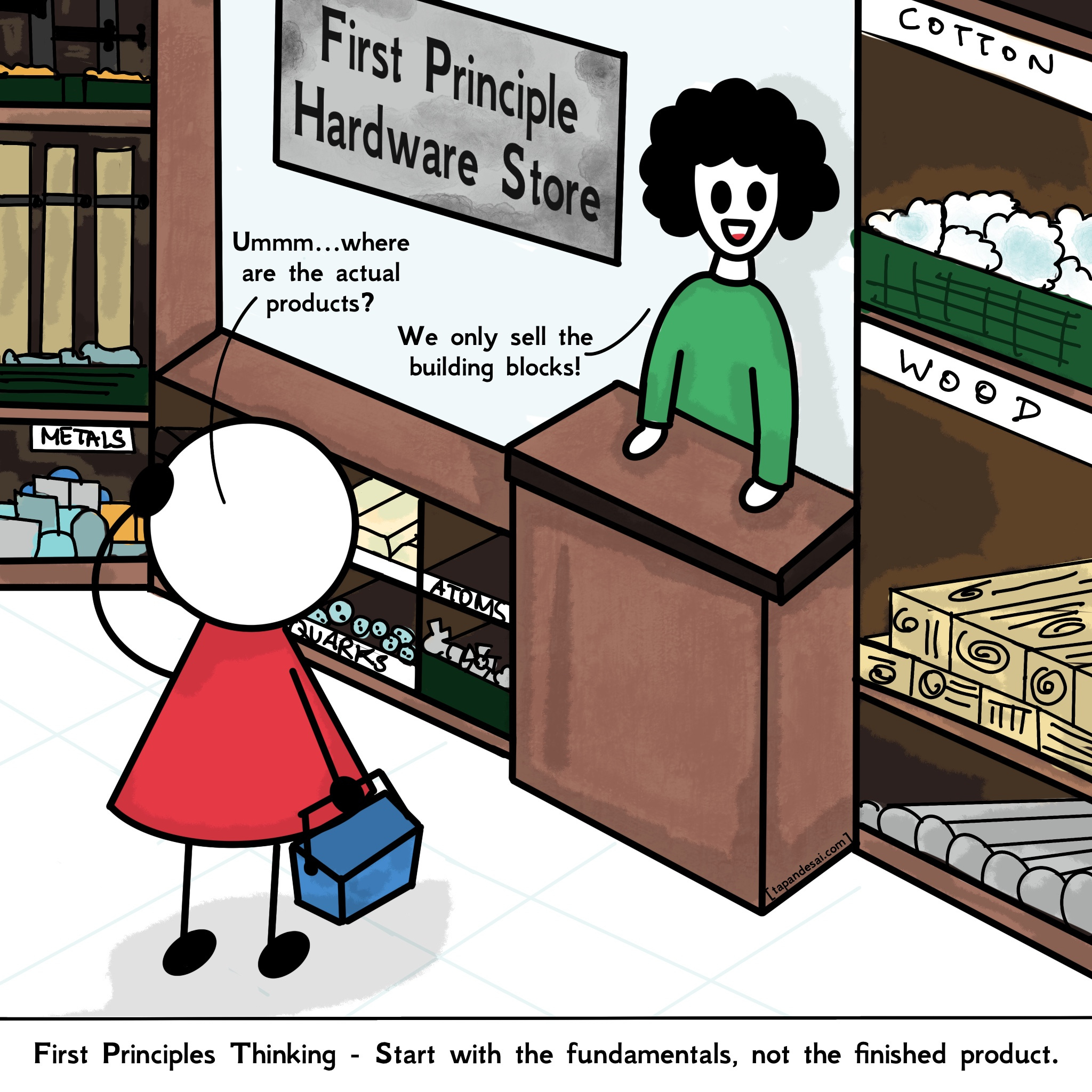
Jensen Huang did the same with timelines. He didn’t ask, “How can we shave 10% off this production schedule?” He essentially asked, “What’s the theoretical minimum time this really takes, and why aren’t we hitting that?”
He reframed a scheduling problem into a physics problem.
If it isn’t physics, it’s policy. And, policies can be changed.
As psychologist Adam Grant writes in Think Again,
We laugh at people who still use Windows 95, yet we cling to opinions that we formed in 1995.
This framework is simply a tool to find the Windows 95 thinking in your work and hit delete.
Closing the Loop at Light Speed
What happened in that NVIDIA conference room wasn’t a clash of egos, it was the collision of two different maps of reality.
One drawn from memory. One drawn from possibility.
Once Huang forced Shoquist to see beyond “how things have always been”, she discovered the hidden straight-line path through the problem.
Most of the walls we run into at work are like that three-week lead time - more habit than reality.
That’s the essence of the Speed of Light framework:
Define the physical limit - Find the absolute fastest reality allows.
Expose the drag - Map the frictions, habits, and rituals that slow you down.
Reverse-engineer from possibility - Start with the ideal and work backward, stripping away everything that isn’t physics.
The point isn’t to worship speed. It’s to dismantle the invisible scaffolding of “how we have always done it.”
Because when you stop navigating by yesterday’s map, you discover the shortest distance to the future.
And the shortest distance to the future is a straight line that no one else believes exists, until you take it.
Until next time,
Tapan (Connect with me by replying to this email)
Thank you for reading! 🙏🏽 Help me reach my goal of 2,300 readers in 2025 by sharing this post with friends, family, and colleagues! ♥️
As an Amazon Associate, tapandesai.substack.com earns commission from qualifying purchases.
I would highly recommend reading this book, especially if you want to learn about AI, how the semiconductor industry works, and Jensen Huang. It’s a beautiful piece of narrative non-fiction, the Thinking Machine!
Yes, 1972! It happened roughly 5,000 years after the invention of the wheel and barely one year after Nasa managed to put two men on the surface of the moon using the largest rocket ever built. We had driven an electric rover with wheels on a foreign heavenly body and even invented the hamster wheel. But drew the line at putting wheels on a box!
Great framing in this piece 🙏